
A green world – a guarantee for a clean future
10:10 29.10.2025 3779

In the period of the Revival of the New Era of the Powerful State, our country is systematically implementing the Law of Turkmenistan “On Renewable Energy Sources” and the National Strategy of the Development of Renewable Energy in Turkmenistan until 2030. The country is successfully implementing the Paris Agreement on Climate Change and its obligations under the UN Framework Convention on Climate Change. As part of the transition to a green economy, measures are being implemented to develop and utilise eco-innovations, to transit to environmentally friendly transport and to improve energy efficiency.
The essence of our approach to developing a green and smart ecosystem in the country and globally was most clearly and accurately expressed by the National Leader of the Turkmen people Hero-Arkadag at the high-level conference of the Third Belt and Road Forum for International Cooperation in China in 2023, “Achieving a balance between production and environment protection and ensuring environmental safety are among the priority objectives of Turkmenistan’s international cooperation.” Consequently, ensuring environmental safety has always been a focus of Turkmenistan’s state policy. A vivid example of this is the city of Arkadag – a bright example of a modern smart city located at the foothills of the picturesque Kopetdag Mountains and based on advanced digital, information, communication and green technologies.
The world is becoming increasingly sensitive to issues of environmental sustainability and global warming. Renewable energy sources are expected to replace traditional fossil fuels. After many years of technological development, investment and commitments to combat climate change, 85% of global energy consumption comes from fossil fuels. This figure demonstrates that the demand for fossil fuels for energy production remains high. Transitioning from fossil fuels to renewable energy is not only costly but also requires economic reforms.
To achieve global energy efficiency, the use of recycled materials, the manufacture of new products, energy conservation and the reduction of greenhouse gas emissions require significantly less energy than raw material extraction. For example, recycling aluminum saves 35% of the energy required to produce new aluminum. This provides significant energy savings for large-scale industrial production.
Paper recycling clearly demonstrates the following benefits:
• Air pollution is reduced by 74-94%;
• Water pollution is reduced by 35%;
• Water consumption can be reduced by up to 45%.
Recycling energy-intensive materials, especially metals, glass, plastic and paper, reduces fossil fuel consumption and carbon dioxide emissions. For example, paper recycling saves energy and helps protect trees, which act as carbon absorbents.
To create an effective waste recycling system, waste separation must begin not only outdoors but also at the key points of generation – at home, in schools and at work. This process of change is simultaneously an environmental awareness, a lifestyle, and a vision for the future. Instilling recycling habits in children, especially at an early age, lays the foundation for a sustainable society.
In this sense, recycling is not only an environmental act, but also:
• social responsibility;
• economic opportunities;
• a powerful tool in the fight against climate change.
Recycling is more than just the conservation of natural resources. Proper separation of each type of waste reduces environmental pollution and increases recycling rates. Recycling and reusing waste such as paper, glass, plastic and metal significantly reduce the consumption of limited natural resources such as forests, minerals, water and energy. For example, recycling paper reduces the number of trees cut down, and recycling plastic waste reduces oil consumption. All of this contributes to ecosystem sustainability and makes the world a place more suitable for life for future generations.
Waste management is one of the most effective ways to prevent environmental pollution. Disposal of waste into soil, water, or the atmosphere poses a threat to nature and creates serious problems. Waste, especially plastic, which can take centuries to decompose, ends up in oceans and soil, causing numerous negative impacts. Recycling these materials not only reduces waste but also prevents air, water and soil pollution.
Recycling not only conserves natural resources but also significantly saves energy and water. Recycling many products requires significantly less energy and water.
• Recycling aluminum provides savings of 35% to 95% compared to producing new aluminum;
• Using recycled paper reduces water consumption by 45%;
• Recycled glass provides energy savings of up to 25% compared to primary glass production.
Natural resources are finite, meaning that natural resources such as water, land, energy, minerals and timber are at risk of rapid depletion due to population growth and consumer habits. Recycling promotes the efficient use of these resources, reducing their consumption.
Small steps toward protecting the environment have a great impact on our lives. Recycling is an environmental movement that creates a greener world in the long term through small individual steps.
Waste-derived energy is used to meet the energy needs of various industries and energy production facilities. These include:
• Power plants. Power plants used to produce electricity can generate energy from waste, reducing the use of fossil fuels and environmental impact.
• Industrial facilities. They can be used to meet the heat or energy needs of various manufacturing facilities.
• Thermal power plants. Fuel derived from waste can be used to generate heat in thermal power plants.
Human development and economic progress must be achieved through long-term, affordable and reliable energy supplies. As the global economy is transitioning to a low-carbon and energy-efficient path, it is necessary to expand the use of renewable energy sources. To realize these opportunities, Turkmenistan is undertaking large-scale government efforts under the direct leadership and supervision of the National Leader of the Turkmen people Hero-Arkadag and Head of State Serdar Berdimuhamedov.
Ogulgerek ATAYEVA,
a student of the State Energy Institute of Turkmenistan
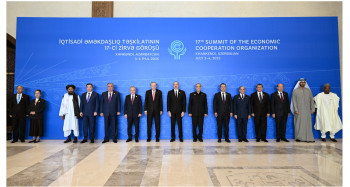
Turkmenistan outlines priority areas of cooperation at the 17th ECO summit
A delegation from Turkmenistan headed by Foreign Minister Rashid Meredov took part in the 17th summit of the Economic Cooperation Organization (ECO) “A New Vision for ECO for a Sustainable and Climate-Resilient Future”, which was held on July 4 in Khankendi, Azerbaijan, the Ministry of Foreign Affairs of Turkmenistan reports (https://www.mfa.gov.tm/ru/news/5383).
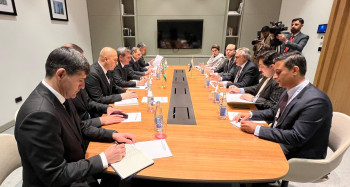
On the sidelines of the 17th ECO Summit, the Foreign Minister of Turkmenistan discussed energy cooperation with the ministers of Pakistan and the UAE
On the sidelines of the 17th ECO Summit, a meeting was held between the Minister of Foreign Affairs of Turkmenistan Rashid Meredov and the Minister of Foreign Affairs of Pakistan Muhammad Ishaq Dar, the Foreign Ministry of Turkmenistan reported on its website on July 4 (https://www.mfa.gov.tm/ru/news/5381).

The Agrarian Party of Turkmenistan approved the candidate for the post of President of the country
On Tuesday, at the Extraordinary IV Congress of the Agrarian Party of Procedure, a candidate for the highest state post of our country was nominated. The deputy khyakim of the Mary region, Agajan Bekmyradov, became the winner.

President of Turkmenistan instructed to study the possibilities of transit of energy resources to the countries of the Middle and Near East
The possibilities of expanding the directions of export of natural gas and electricity from Turkmenistan were discussed at a working meeting held via video link on Tuesday by President Gurbanguly Berdimuhamedov with the participation of Vice-Chairmen of the Cabinet of Ministers of our country, the State News Agency of the country reports.

About 600 tons of polypropylene yarn were exported to Turkey, Russia and Uzbekistan
«Bagtyyar gurlushyk» company exported about 600 tons of polypropylene yarn. In particular, the company sent these products to Turkey, Russia and Uzbekistan, the press service of the Union of Industrialists and Entrepreneurs of Turkmenistan reported.